Religion online shopping search
Simply find the best possible online shopping Religion deals
Religion shopping marketplace results
Shop Religion products and compare prices and listings on popular online marketplaces.
Religion video reviews
Religion news
Religion - BingNovice
What Is Religion?
Co-authored with Dr. Ken Baskin.
Few things are more important to human psychology writ large than religion. But what does this concept really mean?
The more deeply we investigate it, the odder Religion1, as a category of human behavior, seems. For one thing, while almost all scholars agree that it integrates myth and ritual in worship practices, Religion has accumulated dozens of definitions, none of which are universally accepted. Why is it so difficult to find a generally accepted definition for a concept we witness every day?
It is also the case that even first-rate thinkers reach odd conclusions when they try to explain why natural selection should allow people all over the globe to invest so much energy into worshipping what they insist is a superstitious fantasy. Richard Dawkins, for instance, insists that Religion might be the result of neurons that misfire.
Similarly, psychologist Ara Norenzayan argues that powerful, punishing “big gods” made large, impersonal societies possible by convincing people they faced divine retribution if they didn’t work together. Yet, one of the largest societies in world history, China, had no punishing big god during its most glorious periods. Rather, that society made the leader…
6. Are ‘nones’ hostile toward religion?
Some are. But many are not.
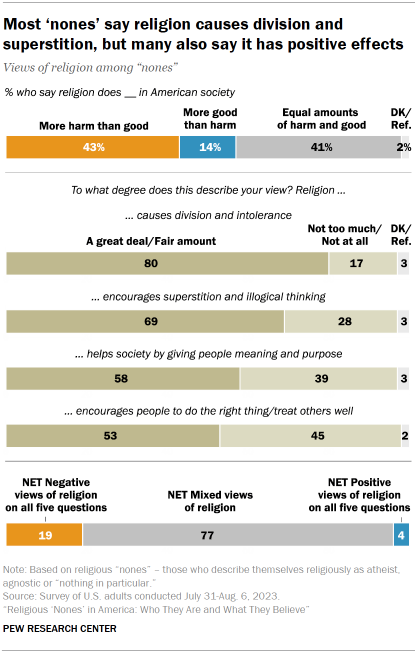
Around a fifth of “nones” express consistently negative views of religion. They say it does more harm than good in society, encourages superstition and causes division. These “nones” also reject a couple of positive statements about religion – that it encourages people to treat others well, and that it helps society by giving people meaning and purpose in their lives.
But most religious “nones” take a more neutral view of religion, expressing a mix of positive and negative opinions about its impact on people’s lives and on society as a whole.
Few “nones” surveyed – just 4% – express consistently positive views of religion.
Views of whether religion does more good or harm
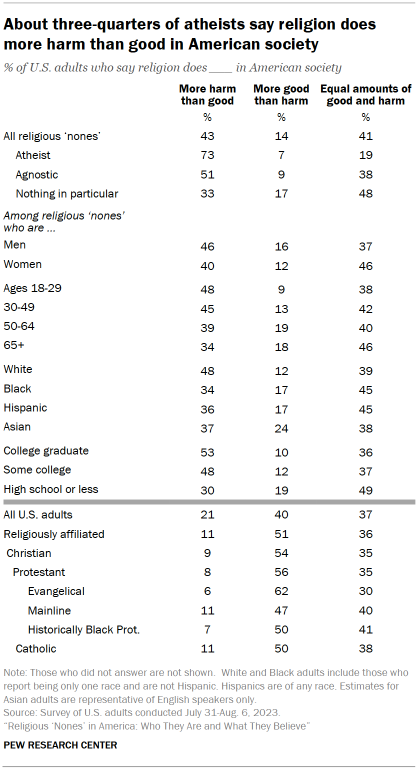
When asked directly, 43% of “nones” say religion does more harm than good in American society. A similar share says religion does equal amounts of good and harm. Fewer religious “nones” (14%) say religion does more good than harm in American society.
“Nones” are much more likely than religiously affiliated adults to believe religion does more harm than good, and much less likely to say religion does more good than harm in American society.
“Nones” with at least some college education…
4. Are all ‘nones’ nonbelievers?
Not all ‘nones’ are nonbelievers.
Far from it.
While the “nones” include many nonbelievers, 70% of “nones” say they believe in God or another higher power, and 63% say they believe in spiritual forces beyond the natural world.
Overall, 19% of religious “nones” are strict nonbelievers who don’t believe in God or any higher power, don’t believe humans have souls, don’t think there’s anything beyond the natural world, don’t think there’s a heaven and don’t believe in hell.
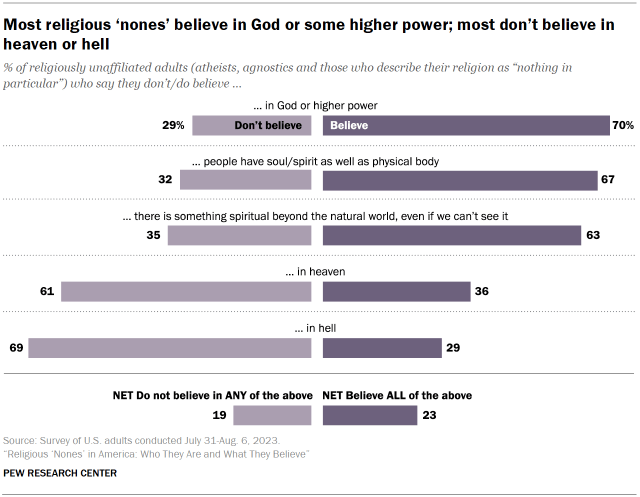
But 23% of “nones” say they believe in all of the above. The rest either hold some of those beliefs and reject others (55%) or else don’t answer enough of the questions to be able to classify the nature of their beliefs (3%).
But ‘nones’ are much less religious, on average, than religiously affiliated Americans.
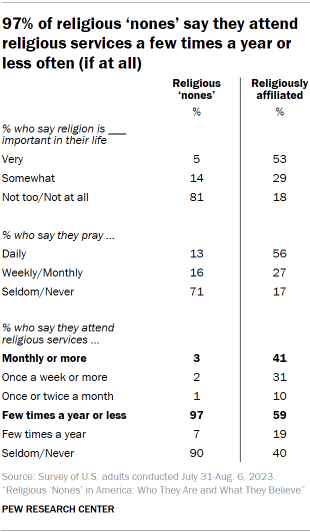
About three-in-ten religious “nones” say they pray with some regularity, but most “nones” don’t. Fully 71% say they seldom or never pray.
While about one-fifth of “nones” say religion is either very or somewhat important in their lives, four times as many say religion is not too or not at all important to them (81%).
And very few “nones” say they attend religious services. Just 3% say…